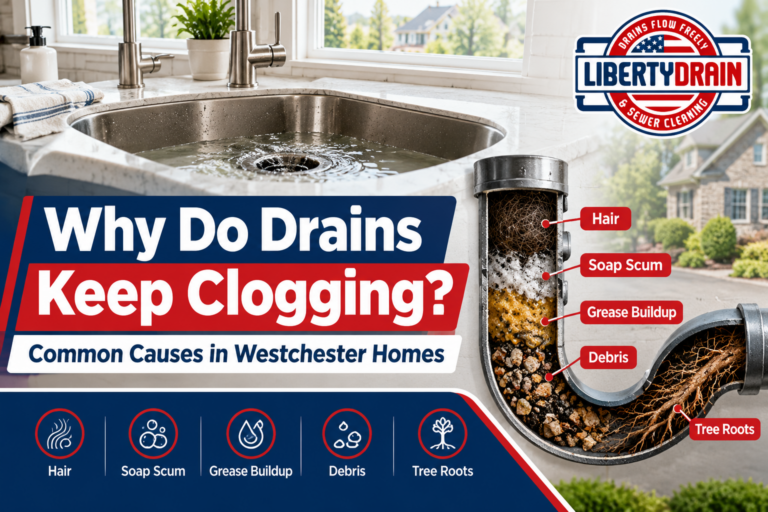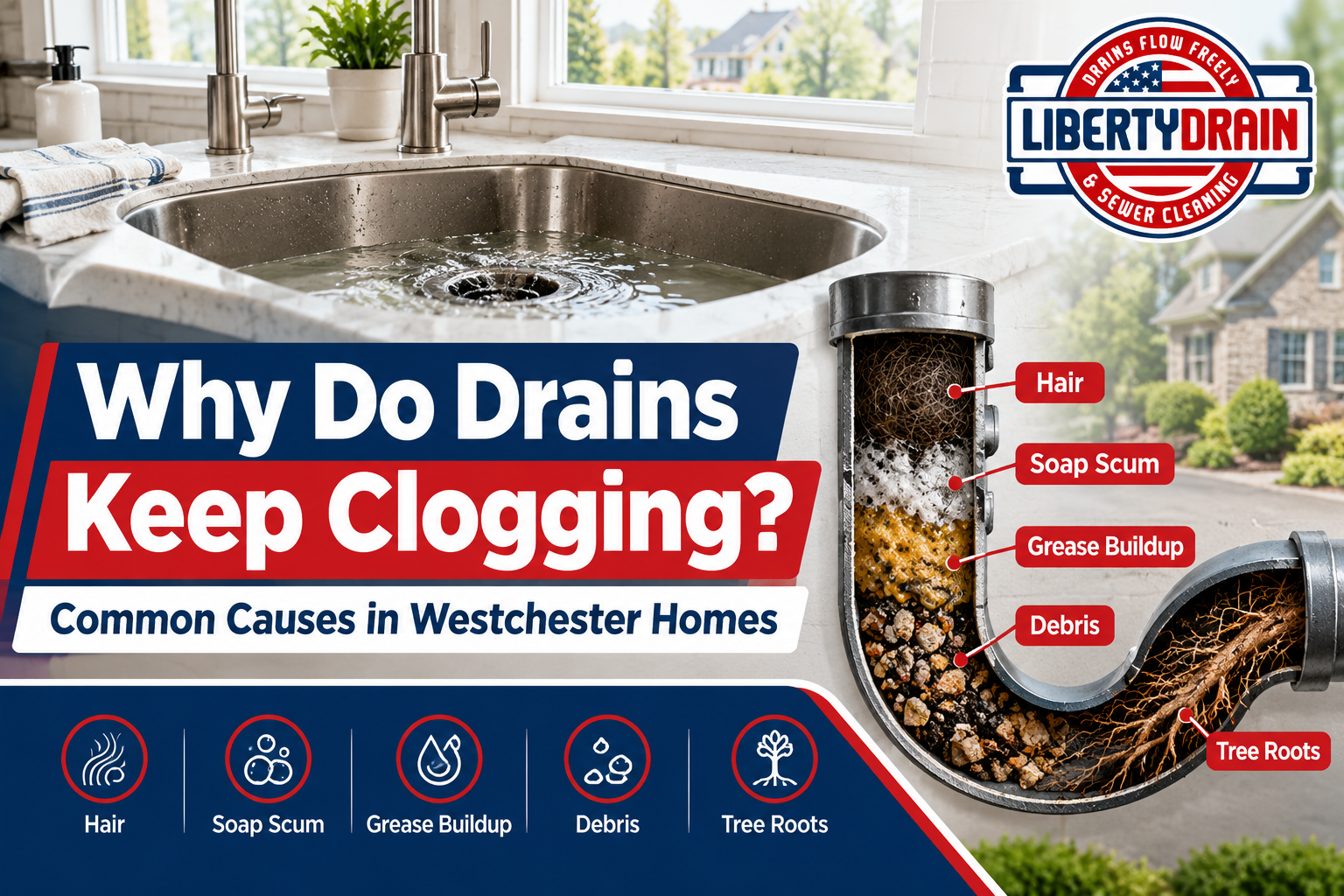
If you’ve plunged the same drain three times this month, you’re not imagining things. A drain that clogs once is annoying. A drain that clogs again and again is trying to tell you something. At Liberty Drain, we get calls from Westchester homeowners every week who ask us the same question: why do drains keep clogging even after we clear them ourselves?
The short answer is that most DIY fixes only clear the surface problem. They don’t touch what’s actually causing it. Let’s walk through what’s really going on in your pipes, and how we help homeowners fix it for good instead of every few weeks.
What Causes Drains to Clog Again After You Clear Them?
When a drain backs up and you plunge it or pour down a store-bought cleaner, you’re usually just pushing the blockage further into the pipe. It moves. It doesn’t leave. That’s why the same sink or tub clogs over and over.
Grease, soap scum, hair, and food particles stick to the inside walls of your pipes. Over time, this buildup narrows the pipe like plaque in an artery. Water can still trickle through at first, which is why things seem “fixed.” Then the buildup catches more debris, and you’re back where you started within a few weeks.
This is one of the biggest reasons behind recurring drain clogs in Westchester homes, especially in older houses with narrower or aging pipes.
Are Older Westchester Homes More Prone to Clogged Drains?
Yes, and it’s not just about age for the sake of age. Many homes in Westchester, especially those built before the 1980s, still have cast iron or galvanized steel piping. These materials corrode from the inside over decades.
As the interior of the pipe rusts and roughens, it creates a texture that grabs onto debris instead of letting it flow through smoothly. Newer PVC piping has a smooth interior that resists this kind of buildup. If your home has original plumbing, that alone could explain why your drains clog more often than a neighbor’s newer build.
We see this constantly in towns like Scarsdale, White Plains, and Yonkers, where a lot of the housing stock is older and full of character, but the pipes underneath haven’t been touched in generations.
Can Tree Roots Really Get into Your Drain Pipes?
They absolutely can, and this is one of the most common causes of clogged drains we find in Westchester specifically. Our area has a lot of mature trees, and tree roots are drawn to the moisture and nutrients inside sewer lines.
Even a tiny crack or loose joint in an underground pipe gives roots an opening. Once they’re in, they grow and spread inside the pipe, catching everything that flows past them. This usually shows up as slow drains throughout the whole house, not just one sink.
If plunging one drain doesn’t help but multiple drains are sluggish at the same time, root intrusion is often the real culprit. This isn’t something a plunger or drain cleaner will ever fix, no matter how many times you try.
Why Do Grease and Soap Buildup Cause Repeated Clogs?
Kitchen sinks and bathroom drains clog for different reasons, but both come down to buildup that hardens over time. In kitchens, grease and oil go down the drain as a liquid when they’re warm. Once they cool inside the pipe, they solidify.
Bathroom drains face a similar issue with soap. Bar soap especially combines with minerals in water to form a substance plumbers call soap scum. It clings to pipe walls and traps hair, skin cells, and other debris.
Rinsing hot water down the drain might melt the top layer, but it doesn’t remove what’s stuck further down. This is exactly why DIY fixes give temporary relief instead of a real solution.
What’s the Difference Between a Simple Clog and a Deeper Drainage Issue?
A simple clog is usually isolated to one fixture and clears easily with a plunger or a drain snake. A deeper drainage issue shows up differently, and it’s worth knowing the signs.
Watch for these patterns:
- Multiple drains clogging around the same time
- Gurgling sounds coming from other drains when you run water
- Water backing up in a different fixture than the one you’re using
- Bad smells coming from drains even when they’re not clogged
- Clogs returning within days or weeks of clearing them
If any of this sounds familiar, the issue likely sits deeper in your plumbing system, not at the surface. This is where we come in with camera inspections and hydro jetting to actually see and clear what’s causing the problem.
How to Prevent Drain Clogs Before They Start
Prevention beats repeated plunging every single time. A few small habits go a long way toward keeping your drains clear.
Use a drain strainer in every sink, tub, and shower to catch hair and food debris before it goes down. Let grease cool and toss it in the trash instead of the sink. Run hot water through kitchen drains after each use to keep grease from settling.
Beyond daily habits, scheduling a professional drain cleaning once a year makes a real difference. We use hydro jetting at Liberty Drain, which clears buildup from the inside of the pipe rather than just breaking through the middle of a clog. It’s a big part of how to prevent drain clogs long term instead of just reacting to them.
How We Help Westchester Homeowners Fix Recurring Clogs
We know it’s frustrating to keep dealing with the same clog. That’s why our approach starts with finding the actual cause, not just clearing the immediate blockage. We use video camera inspections to look inside your pipes and see exactly what’s happening, whether that’s root intrusion, corrosion, or years of buildup.
From there, we recommend the right fix for your specific situation. Sometimes that’s hydro jetting. Other times it’s targeted repair or replacement of an aging pipe section. Either way, our goal is to stop the cycle so you’re not calling a plumber every month for the same problem.
Homeowners across Westchester trust us because we explain what we find in plain language and give honest recommendations, not upsells. If your drains keep clogging no matter what you try, give us a call and let’s actually solve it.
Frequently Asked Questions
How often should Westchester homeowners get their drains professionally cleaned?
Most homes benefit from a professional drain cleaning once a year. Homes with older pipes, mature trees nearby, or a history of frequent clogs may need service every six months. Regular cleaning removes buildup before it narrows pipes enough to cause backups, which saves money compared to emergency calls later.
Is it normal for a drain to gurgle even when it’s not clogged?
No, gurgling usually means air is trapped somewhere in your plumbing system, often because of a partial blockage further down the line. It’s not something to ignore. If gurgling happens regularly, it’s worth having a plumber inspect the drain before it turns into a full backup.
Can pouring boiling water down a drain damage older pipes?
Yes, boiling water can damage PVC pipes by softening the plastic or loosening joints over time. It’s safer for metal pipes but still not a reliable fix for real clogs. Hot tap water is fine for regular maintenance, but boiling water is a risk not worth taking.
What does hydro jetting actually do differently than a drain snake?
A drain snake breaks a hole through the middle of a clog, while hydro jetting uses high pressure water to scour the entire inside wall of the pipe. This removes grease, scale, and debris completely instead of leaving buildup behind, which is why clogs return less often after jetting.
Why do multiple drains in my house clog around the same time?
This usually points to a blockage in your main sewer line rather than individual fixtures. Since every drain in your home connects to that main line, a clog there affects everything at once. This pattern almost always needs a camera inspection to find the exact cause and location.
Are chemical drain cleaners safe to use regularly on Westchester plumbing?
No, regular use of chemical drain cleaners can corrode pipes over time, especially older metal plumbing common in Westchester homes. They also don’t address the root cause of recurring clogs. Occasional use on a minor clog is generally fine, but they shouldn’t replace professional cleaning or inspection.